
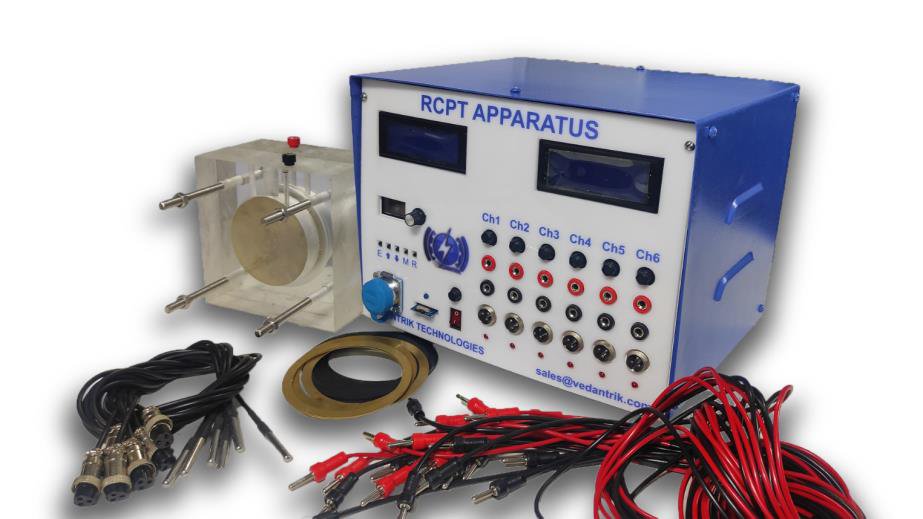
RCPT Test in India
At PGSD Testing Labs, the RCPT test in India, or Rapid Chloride Penetration Test, is an essential evaluation method used to assess the durability of concrete against chloride ion penetration. This test plays a crucial role in determining the longevity and performance of concrete structures, especially those exposed to harsh environments, such as coastal areas, where chloride exposure can lead to corrosion of reinforcing steel. The RCPT test in India helps engineers and construction professionals make informed decisions about mix designs and the overall quality of concrete, ensuring that structures remain safe and durable throughout their lifespan. The RCPT test in India begins with the preparation of concrete samples, which are typically cylindrical in shape and must be cured properly to achieve the desired strength. Once the samples are prepared, they are subjected to a voltage across their surface while immersed in a sodium chloride solution. This procedure allows for the measurement of the electrical current that passes through the concrete, which is directly related to the permeability and ion transport properties of the material. The RCPT test in India provides valuable quantitative data, enabling engineers to determine the concrete's resistance to chloride ion ingress effectively. The results obtained from the RCPT test in India are expressed in terms of the total charge passed, measured in coulombs, over a specified duration, usually six hours. This data allows for the classification of concrete into different categories based on its permeability, which is essential for selecting appropriate materials and construction methods for specific projects.
High permeability indicates a higher risk of corrosion and reduced durability, while low permeability suggests better resistance to chloride penetration. The insights gained from the RCPT test in India are instrumental in optimizing concrete formulations to achieve desired performance levels. In addition to evaluating the concrete's resistance to chloride ions, the RCPT test in India also serves as a quality control measure during the construction process. By conducting this test on-site or in the laboratory, construction professionals can verify that the concrete used in their projects meets the necessary specifications for durability and performance. Regular testing throughout the construction phase ensures that any issues related to mix design or material quality can be identified and addressed promptly, thereby minimizing potential risks associated with long-term durability. The applications of the RCPT test in India are vast and span various sectors, including infrastructure development, residential and commercial construction, and repair and rehabilitation projects. In infrastructure development, for example, the RCPT test in India is particularly valuable for assessing the quality of concrete used in bridges, highways, and tunnels, where exposure to deicing salts and other corrosive agents is common. By ensuring that the concrete meets durability standards, engineers can enhance the lifespan and safety of these critical structures. At PGSD Testing Labs, we are committed to delivering high-quality testing services that meet the specific needs of our clients. Our team of experienced professionals is dedicated to conducting the RCPT test in India with precision and adherence to industry standards. We employ state-of-the-art equipment and methodologies to ensure accurate and reliable results, providing clients with the confidence they need for their construction projects. After conducting the RCPT test in India, we provide comprehensive reports that detail the findings, including analyses and recommendations for improving concrete durability. These reports are designed to help engineers and project managers make informed decisions regarding mix designs and construction practices, ultimately leading to more resilient structures. In conclusion, the RCPT test in India is a vital tool for assessing concrete durability and ensuring the long-term performance of structures exposed to chloride ions. By choosing PGSD Testing Labs for your RCPT test in India, you invest in high-quality testing services that deliver critical insights into the properties of concrete. Our expertise and commitment to excellence ensure that your projects are based on accurate data and sound engineering principles, contributing to the overall safety and longevity of your constructions.
Features Of RCPT Test
At PGSD Testing Labs, the RCPT test in India, or Rapid Chloride Penetration Test, offers several key features that make it an essential tool for evaluating the durability of concrete. This test specifically assesses the permeability of concrete to chloride ions, which is critical for preventing corrosion of reinforcement bars in structures exposed to harsh environments. The RCPT test in India utilizes a systematic approach where concrete samples are subjected to a voltage while immersed in a sodium chloride solution, allowing for the measurement of the electrical current that passes through the material. This provides quantitative data on the concrete's resistance to chloride penetration. One of the standout features of the RCPT test in India is its efficiency; results are typically available within a few hours, enabling timely decision-making in construction projects. The data collected helps classify concrete into various categories based on permeability, guiding engineers in optimizing mix designs and ensuring compliance with durability standards. Additionally, the RCPT test in India serves as a quality control measure, allowing for on-site or laboratory testing to verify that concrete meets specified performance criteria. This proactive approach helps identify any issues early in the construction process, ensuring that long-term durability is maintained. By employing advanced testing methodologies and precise instrumentation, PGSD Testing Labs delivers reliable and actionable insights through the RCPT test in India, enhancing the safety and longevity of concrete structures.
Specification of RCPT Test
At PGSD Testing Labs, the RCPT test in India, or Rapid Chloride Penetration Test, is designed to assess the chloride ion permeability of concrete, which is crucial for evaluating its durability. The testing process begins with the preparation of concrete samples, typically cylindrical in shape, that are cured to the specified strength. The RCPT test in India utilizes a standardized setup where each sample is subjected to a voltage while immersed in a sodium chloride solution, facilitating the measurement of the electrical current passing through the concrete. The results of the RCPT test in India are expressed in coulombs, indicating the total charge passed over a six-hour duration. This data helps classify the concrete’s permeability into various categories, such as low, moderate, or high permeability, allowing engineers to make informed decisions regarding mix design and suitability for specific applications. In addition to providing valuable insights into concrete performance, the RCPT test in India serves as a quality control measure during construction. It can be conducted both on-site and in the laboratory, ensuring that the concrete used meets required durability standards. PGSD Testing Labs employs advanced equipment and follows stringent protocols to ensure accuracy and reliability in results. Detailed reports are provided, offering analyses and recommendations based on the findings. Overall, the RCPT test in India is an indispensable tool for enhancing the safety and longevity of concrete structures, contributing to informed engineering practices and successful project outcomes.
IF YOU HAVE ANY REQUIRMENT PLEASE CONATCT US